
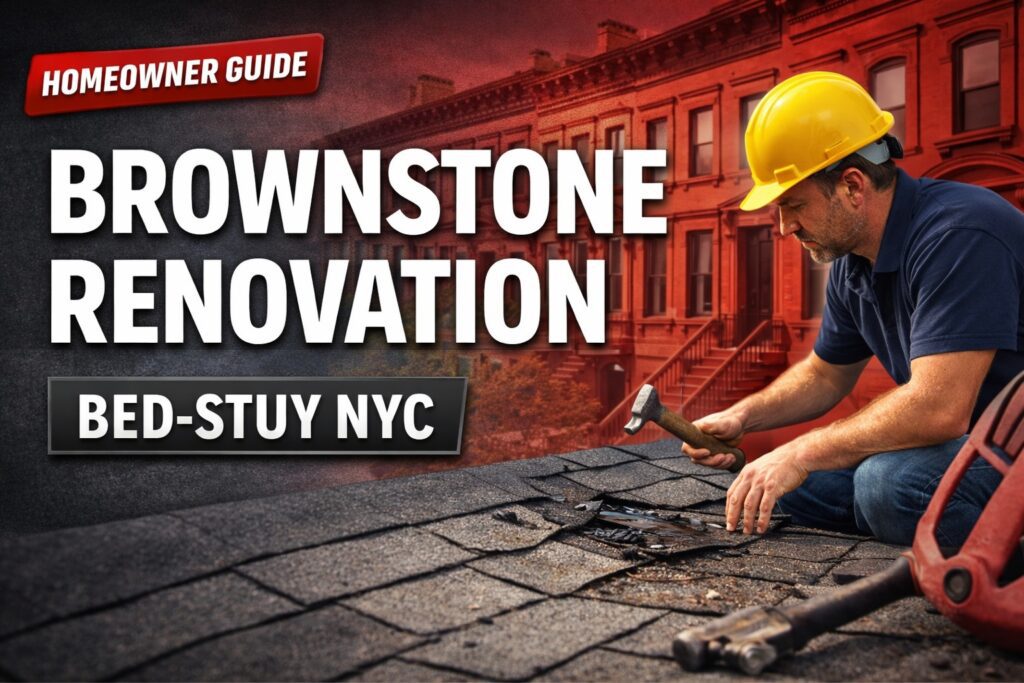
Bedford-Stuyvesant has the largest collection of intact Victorian-era architecture in the entire United States. Roughly 8,800 buildings in this neighborhood were constructed before 1900, and many of them are the ornate brownstone rowhouses that define Brooklyn’s identity. If you own one of these properties, you are sitting on a piece of New York City history.
But owning a Bed-Stuy brownstone also means taking responsibility for a building that is well over 100 years old. These homes are beautiful, but they come with real challenges. Sandstone facades crack and spall. Mortar joints fail. Roofs reach the end of their lifespan. Basements take on water. And if your property falls within one of Bed-Stuy’s two historic districts, you have an additional layer of regulations to navigate before you can start any exterior work.
I have been working on Bed-Stuy brownstones with AKRoofing3D for over a decade. In this guide, I am going to walk you through what a brownstone renovation actually involves in this neighborhood, what it costs, what permits you need, and how to avoid the mistakes that cost homeowners thousands of dollars.
What Does a Brownstone Renovation Actually Include?
The term “brownstone renovation” gets used loosely. For some homeowners, it means a full gut renovation from the foundation to the roof. For others, it means restoring the exterior facade and stoop. And for many Bed-Stuy owners, it falls somewhere in between.
Here are the most common exterior renovation projects we handle on Bed-Stuy brownstones:
Facade Restoration
The brownstone facade is the front face of your building. It is made from a soft sandstone veneer that was applied over a brick structural wall. Over time, this sandstone develops cracks, chips, and areas where the surface layer separates from the brick backing. This process is called spalling, and it is the single most common issue on Bed-Stuy brownstones.
Facade restoration can range from spot patching small areas of damage to a full resurfacing of the entire front wall. Our team uses brownstone-compatible patching compounds that are custom tinted to match your building’s original color. For severe cases where the sandstone has eroded down to the brick, we apply a new brownstone-finish coating over the entire facade to create a uniform appearance.
Stoop Restoration
The front stoop is one of the most recognizable features of a Bed-Stuy brownstone. Original stoops were built from solid brownstone blocks, and after more than a century of foot traffic, weather, and settlement, many of them are in rough shape. Cracked treads, tilting risers, loose railings, and eroded surfaces are all common problems.
Stoop restoration can mean resurfacing the existing stone, rebuilding individual treads and risers, or in some cases, tearing out the old stoop and constructing a new one that matches the original design. Our stoop and steps team has done all three on Bed-Stuy properties.
Cornice Repair
The cornice is the decorative molding that runs along the roofline of the building. On many Bed-Stuy brownstones, cornices feature elaborate details like dentil molding, scrollwork, and bracketed overhangs. These elements are often made from galvanized sheet metal, wood, or brownstone, and all three materials deteriorate over time.
A damaged cornice is more than a cosmetic issue. Loose cornice sections can fall to the sidewalk below, creating a serious safety hazard. The NYC Department of Buildings requires property owners to maintain their facades and cornices in safe condition under Local Law 11, also known as the Facade Inspection Safety Program (FISP). Buildings over six stories are subject to mandatory inspections, but even smaller buildings can receive violations for visibly deteriorating cornices.
Brick Pointing
While the front facade of a Bed-Stuy brownstone is sandstone, the side walls and rear walls are almost always exposed brick. These brick walls need regular brick pointing to keep moisture out. On a typical Bed-Stuy brownstone, the side wall mortar joints fail first because they are exposed to the most wind-driven rain.
We use lime-based mortar on Bed-Stuy brownstones with original soft brick. This is critical because modern Portland cement mortar is harder than the brick itself. When hard mortar is applied to soft brick, the brick absorbs all the stress from expansion and contraction, and it cracks. Lime mortar is softer and more flexible, which allows it to move with the building instead of damaging it.
Roofing
Most Bed-Stuy brownstones have flat roofs. These roofs have a typical lifespan of 15 to 25 years depending on the material and maintenance. If your flat roof is leaking, showing signs of ponding water, or has visible membrane damage, it is time to talk to a roofing contractor.
We install EPDM rubber, TPO, and modified bitumen roof systems on Bed-Stuy brownstones. A new flat roof also gives you the opportunity to add a skylight to bring natural light into top-floor rooms.
Waterproofing
Basement moisture is a fact of life in Bed-Stuy. These brownstones were built with stone or early concrete foundations that were never waterproofed by modern standards. Over a century of settling, root intrusion, and changing water table levels has left many basements damp or prone to flooding.
Our waterproofing team installs interior French drains, sump pumps, vapor barriers, and crack injection systems. For buildings where interior solutions are not enough, we perform exterior waterproofing by excavating along the foundation, applying a rubberized membrane, and regrading the soil to direct water away from the building.
Exterior Painting
A proper exterior paint job on a Bed-Stuy brownstone protects the window frames, cornice, trim, and any wood elements from moisture and UV damage. We prep every surface thoroughly, including scraping, sanding, priming, and caulking, before applying two coats of high-quality exterior paint rated for the New York climate.
How Much Does a Brownstone Renovation Cost in Bed-Stuy?
Costs vary widely depending on the scope of work. Here are realistic ranges based on what we have seen on Bed-Stuy projects in 2025 and 2026:
Facade spot patching and minor repairs: $3,000 to $10,000. This covers localized areas of spalling, small cracks, and surface damage.
Full facade resurfacing (front wall): $15,000 to $40,000. This includes grinding out the damaged surface, applying a new brownstone-finish coating, and restoring decorative details.
Stoop restoration: $8,000 to $30,000. Simple resurfacing falls at the lower end. A full stoop rebuild with new brownstone treads, risers, and railings falls at the higher end.
Cornice repair: $5,000 to $20,000 depending on the material (metal vs. wood vs. stone), the extent of the damage, and whether scaffolding is required.
Full brick pointing (side and rear walls): $10,000 to $25,000 for a standard three-story brownstone. The price depends on total square footage and mortar condition.
Flat roof replacement: $8,000 to $18,000 for a typical brownstone footprint with EPDM or TPO membrane.
Basement waterproofing: $5,000 to $25,000 depending on whether you are doing interior drainage only or full exterior excavation and membrane application.
Full exterior renovation (facade, stoop, pointing, cornice, roof, paint): $60,000 to $150,000 or more for a comprehensive project on a three-story brownstone.
These numbers are specific to Bed-Stuy. Costs in neighborhoods like Park Slope or Brooklyn Heights may run higher due to stricter LPC requirements and higher demand for specialized contractors.
Bed-Stuy Historic Districts: Permit Rules You Need to Know
This is where a lot of Bed-Stuy homeowners run into trouble. The neighborhood contains two designated historic districts, and if your property is in one of them, the rules are different.
Stuyvesant Heights Historic District
This was one of the first historic districts designated in Brooklyn, established in 1971. It covers a section of the neighborhood south of Fulton Street, roughly bounded by Tompkins Avenue, MacDonough Street, Stuyvesant Avenue, and Chauncey Street. The district includes some of the finest examples of Romanesque Revival and Neo-Grec brownstones in the city.
Bedford Historic District
Designated in 2015, this is a newer and larger historic district covering over 800 buildings in the western portion of Bed-Stuy. It extends from roughly Classon Avenue to Nostrand Avenue and from Atlantic Avenue to Fulton Street.
What the LPC Requires
If your property is within either of these districts, you need Landmarks Preservation Commission approval before making any changes to the exterior that are visible from a public street or sidewalk. This includes:
- Facade repairs and resurfacing
- Stoop reconstruction or alteration
- Window replacement (material, style, and profile must match the historic character)
- Cornice repair or replacement
- Changes to exterior paint color
- Installation of new railings, gates, or fences
- Rooftop additions or changes to the roofline visible from the street
The LPC review process adds time to a project, typically two to six weeks depending on the complexity of the application. Some minor repairs qualify for a staff-level permit, which is faster. Larger projects may require a full hearing before the commission.
Our team has filed multiple LPC applications for Bed-Stuy projects. We know what materials and methods the commission prefers, and we prepare applications that align with their standards. This reduces the chances of delays or rejections.
What If Your Property Is Not in a Historic District?
Even outside the historic districts, the NYC Department of Buildings requires permits for certain types of work. Roof replacements, structural alterations, and scaffold installations all require DOB permits. We handle the permit filing for every project that requires one, so you do not have to deal with the paperwork yourself.
Common Mistakes Bed-Stuy Homeowners Make During Renovation
After working on brownstones in this neighborhood for over a decade, I have seen the same mistakes come up again and again. Here are the biggest ones and how to avoid them.
Using the Wrong Mortar
This is the most damaging mistake I see. A contractor uses Portland cement mortar on a building with 130-year-old soft brick, and within a few years, the bricks start cracking and spalling. Once the brick is damaged, you are no longer looking at a pointing job. You are looking at brick replacement, which costs significantly more. Always ask your contractor what type of mortar they plan to use and why.
Skipping the Waterproofing
A lot of homeowners invest in a beautiful facade restoration and forget about what is happening below grade. If your basement is wet, that moisture is wicking up through the walls and undermining the work you just paid for above. Address water issues first or at the same time as the facade work.
Starting Work Without LPC Approval
If your property is in a historic district and you start exterior work without LPC approval, you can receive a violation from the commission. The penalties include stop-work orders, fines, and the potential requirement to undo completed work that does not meet historic standards. Check your property’s landmark status before you hire a contractor.
Hiring Based on Price Alone
The cheapest estimate is rarely the best value on a brownstone. Low-cost contractors often cut corners on materials, skip proper surface prep, and use mortar that does not match the building. You end up paying again in two or three years when the work fails. Get multiple estimates, but evaluate them based on the scope of work, materials, and the contractor’s experience with brownstones.
Ignoring the Cornice
Because the cornice is at the top of the building and harder to see, homeowners often overlook it. But a deteriorating cornice can drop debris onto the sidewalk, which creates a liability issue. And once the DOB issues a violation, you are on the clock to get it fixed. Include the cornice in any exterior inspection so you are not caught off guard.
How to Choose the Right Contractor for a Bed-Stuy Brownstone
Not every contractor is qualified to work on a 130-year-old brownstone. Here is what to look for:
Brownstone-specific experience. Ask to see photos and references from past brownstone restoration projects. General contractors who mostly do new construction may not understand the techniques and materials required for historic masonry.
Knowledge of lime mortar. If a contractor does not mention lime mortar when discussing an older Bed-Stuy brownstone, they may not have the specialized knowledge the job requires.
LPC experience. If your property is in a historic district, your contractor should be familiar with the LPC application process and the standards the commission enforces.
NYC licensing and insurance. Verify that your contractor is licensed with the NYC Department of Buildings and carries general liability and workers compensation insurance.
A detailed written estimate. The estimate should break down costs by category (facade, stoop, pointing, roofing, etc.), specify the materials being used, and include a project timeline.
AKRoofing3D has been doing brownstone renovation work in Bed-Stuy for over a decade. We handle everything from minor facade repairs to full exterior restorations, and we manage the LPC and DOB permit process from start to finish. Browse our project gallery to see examples of our completed brownstone work.
Get a Free Estimate for Your Bed-Stuy Brownstone
Planning a renovation on your Bed-Stuy brownstone? Call us at (646) 492-0756 or fill out our online quote form. We will schedule an on-site inspection, walk you through what your building needs, and provide a detailed estimate with no obligation.
Your brownstone has stood on that block for more than a century. With the right care, it will stand for another one.
Frequently Asked Questions About Brownstone Renovation in Bed-Stuy
How do I find out if my Bed-Stuy brownstone is in a historic district?
You can search your address on the NYC Landmarks Preservation Commission website at nyc.gov/landmarks. The site has an interactive map that shows all designated historic districts and individual landmarks. You can also call us, and we will verify your property’s status before we start any work.
How long does a full exterior brownstone renovation take in Bed-Stuy?
A comprehensive exterior renovation covering the facade, stoop, brick pointing, cornice, and roofing typically takes 6 to 12 weeks on a standard three-story Bed-Stuy brownstone. The timeline varies based on the scope of work, weather conditions, and whether LPC approval is needed. We provide a detailed project schedule before work begins.
Can I renovate my brownstone in phases?
Yes, and many Bed-Stuy homeowners do exactly that. A phased approach lets you spread the cost over time. We help you prioritize which work needs to happen first based on urgency. For example, a leaking roof and failing waterproofing should come before cosmetic facade repairs. We create a multi-phase plan that makes sense for your building and your budget.
What is the difference between brownstone restoration and brownstone renovation?
Restoration means bringing the building back to its original condition using historically accurate materials and methods. Renovation is a broader term that can include modernizing the building with new materials, layouts, or features. In Bed-Stuy historic districts, restoration is generally what the LPC requires for any exterior work. We specialize in both approaches depending on the property and the homeowner’s goals.
Do I need scaffolding for brownstone facade work?
In most cases, yes. Any facade work above the first story requires some form of elevated access. For two- and three-story buildings, we typically use pipe scaffolding. Taller buildings may require a sidewalk shed and swing stage. Scaffolding adds cost to the project, but there is no safe way to do quality facade work at height without it. We include scaffolding costs in every estimate so there are no surprises.
Will my brownstone renovation increase my property value?
A well-executed exterior renovation can significantly increase the market value of a Bed-Stuy brownstone. A restored facade, rebuilt stoop, and new roof are among the most visible upgrades a buyer or appraiser will notice. In a neighborhood where median home prices have risen sharply over the past five years, maintaining and improving the exterior condition of your brownstone is one of the smartest investments you can make.
What happens if I do exterior work without LPC approval in a historic district?
The LPC can issue a warning letter, a notice of violation, or a stop-work order. In serious cases, you may be required to undo the completed work and redo it according to LPC standards, which means paying for the same project twice. The commission can also impose fines. The simplest way to avoid this is to check your landmark status and file the proper application before construction begins.
How do I get started with my Bed-Stuy brownstone renovation?
Call us at (646) 492-0756 or fill out our online quote form. We will schedule a free on-site inspection where we evaluate the condition of your facade, stoop, cornice, brick walls, roof, and foundation. After the inspection, we provide a detailed written estimate with recommended priorities and a project timeline.